Village · Houses
Once We Peeled Jute Together 🌱
Village · Houses
Once We Peeled Jute Together 🌱
🌬️I want to tell you that back in the day, back then... when the cold wind came, we all went to peel jute at the Thai pavilion 😁 During school holidays when we earned money... I remember it well, little one 🌻
🌻 They say like this... "peeling jute" means... our house grew white jute..
🌱 White jute was chosen as one of the important economic crops popularly grown in the Northeast, because jute is not difficult to plant at all. You just need to find a forest clearing that doesn't flood (na khok), clear it open and flat, plow it a bit, and by April you take jute seeds to drop into holes (dug with a hoe, a siem, or a pointed stick), 3-4 seeds per hole, spread soil to cover, and step firmly to pack it. After Songkran ends, when rain starts to fall, the jute begins to sprout. With good sunlight and humidity from the rain mist, the jute will grow beautifully without needing much fertilizer at all.
🌀 Then around May-June, when the jute plants are about knee-high, farmers start weeding (in Isaan dialect called "sia ya" - sia means to destroy). In Korat they call it "dai hun" or "tam run." Some places call it "ao hun," which is just "dai ya" (weeding) in the Central region. This is to prevent grass from stealing nutrients from the jute plants. There aren't really pest insects to worry about; what you must watch out for are cattle and buffalo, which might come eat the jute leaves and destroy the crop.
🌀 Then when rice-planting season arrives, we leave the jute field and go handle transplanting rice first. When the rain ends around early October-November, it's time to harvest the jute. Mature jute plants have stems about 2.5-3 meters tall with thick bark. Harvesting just requires a sharp eto knife, slicing diagonally at the base of the stem, then gathering and bundling them together. Each bundle is about 10-12 inches in diameter. They're piled together (normally jute cutting isn't done as communal labor, but hired work to distribute income in the village; households with many workers don't need to hire).
🌀 After that, the jute stem bundles are transported to soak in water at the head of the field, end of the paddy, or public areas like roadside canals (but not in public ponds used for consumption water). Normally jute stems have light wood that doesn't sink, so to soak the bundles you must use heavy logs to weigh them down, or use rocks, mud, or clay to add weight. Soaked for about 3-4 weeks, the stem bark pulp rots away, leaving only the tough, soft, strong jute fibers. When this soaking causes the jute stem bark to rot, it gives off a foul stench that can be smelled from more than 50 meters away, I tell you.
🌱 In the past, the soaking places were along the rural highway, from Khun Mae Thongpan's house, past the 7/11 intersection toward Nong Phakchi, and around the 7/11 area, the way to Krok Kula near the ice factory.
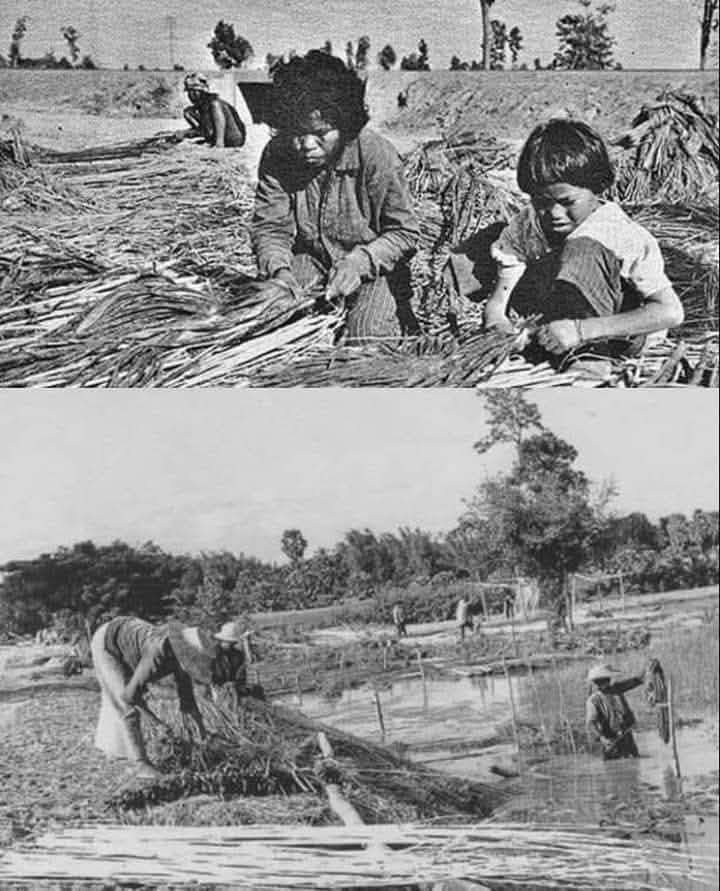
🌀 The next step, the most classic one, is "peeling jute," because the workers get full vitamin D from sunlight and the strong stench from the jute bundles. You couldn't refuse because Father and Mother would reward you with new school uniforms when the jute sold, or new festival clothes (for temple visiting) if we got good money. Each person would find a suitable spot on the water's edge, convenient for pulling the bundles up on shore. Cut the binding ropes at the head, middle, and end of the bundle. Then pick up 3-4 stems, use fingernails to scratch and pull the jute fibers out together, pulling from the base to the tip. Lay the fibers in rows, and toss the bare stems aside 😁
🌀 When enough fibers are collected before the bark dries, they're carried to clean water and beaten against the water surface to loosen the bark pulp, until clean transparent fibers are obtained, then sun-dried. Getting good quality jute fiber isn't easy - it requires diligence and patience, with careful work. If you're impatient, the peeling will slip and break in sections, giving short fibers. Or if you're too slow and let the bark dry before washing, it won't be clean and you'll have to redo it many times. Plus you get the stench on your body, clothes, face and hair. Back then we didn't know about using cloth to cover mouth and nose, or gloves. Those who endured did it purely for money - for a bowl of noodles from Mae Yai Pung back then 🍜
🌱 As for the jute stems, they became jute wood, used for many purposes - fuel for cooking, making fences, making this and that, etc.
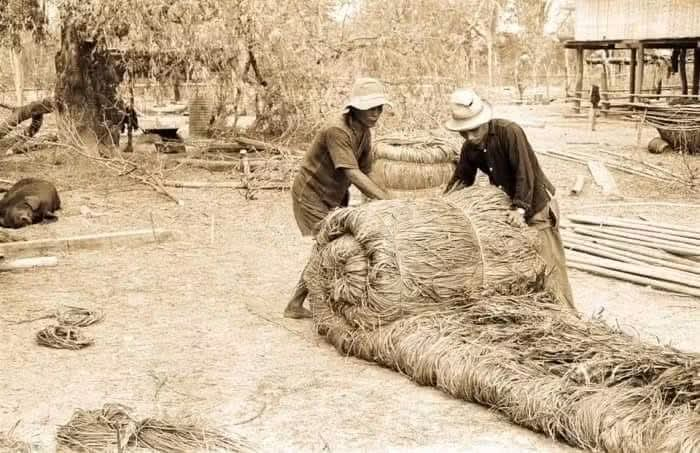
🌀 When the jute is dried, it's bundled into large rolls (khon), about 100-150 kilograms each, and sold to merchants who come to buy at the house. The jute fiber was sent to factories for making burlap sacks. Back then these were around Sikhiu district, Sung Noen, Muang Korat, or sometimes at our Ban Nong Chim we sold to the boss, Mae Yai Thanom. And the jute that was bundled became burlap sacks for holding paddy rice and milled rice, as you see.
🌳 The stench from soaking and peeling jute - on clothes, hair, nails - hard to describe. Going to school, friends would make disgusted faces and tease each other about smelling bad, but no one got angry, just joking around. The teachers didn't scold either, but rather praised us: "Hardworking in helping with housework, knowing how to earn money to spend and help the family - a good example." But we should bathe, wash our hair clean, wash and sun-dry clothes thoroughly so no stench lingers. But it was very classic, I tell you, that era.
🌴 Today, jute cultivation is in the past - it's planted less in some areas. Traveling past many places along the roads, you hardly see jute soaking or peeling anymore, brothers and sisters.
Share this story
2 more photos below